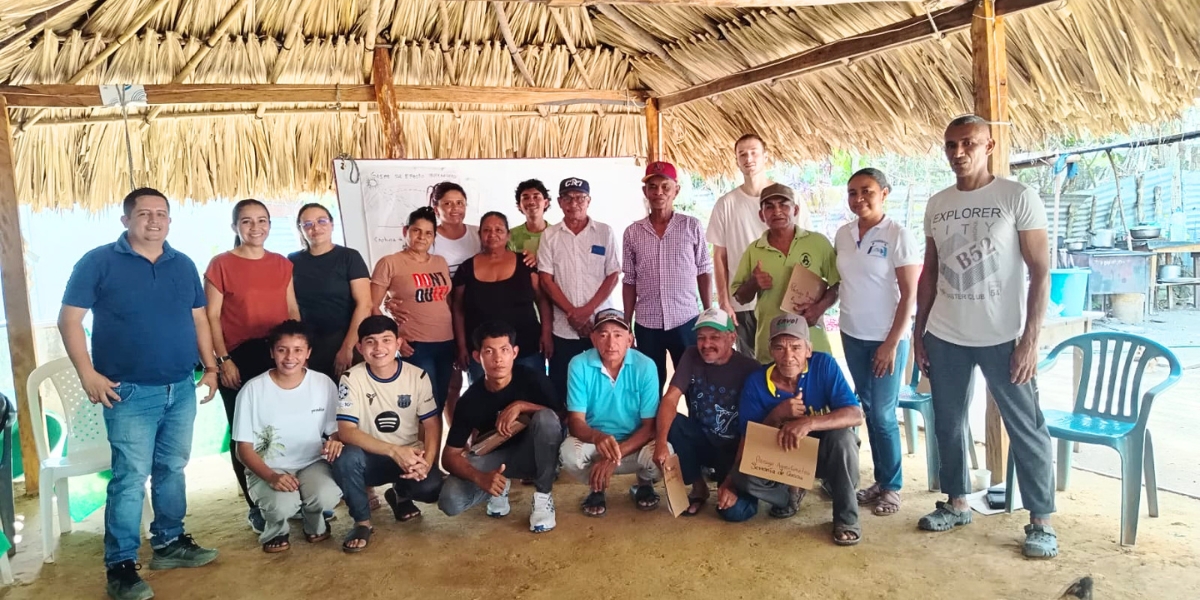
Envol Vert Colombia conducted a nine-month participatory assessment in collaboration with the Patrimonio Natural Fund in two agro-natural landscapes in the Montes de María. Here, we share the timeline of this large-scale project.
A bit of context
In the departments of Sucre and Bolívar, the “De raíces a mareas: ecosistemas resilientes” (“From Roots to Tides: Resilient Ecosystems”) project is moving forward with the development of a roadmap to address environmental challenges associated with climate change. Led by Fondo Patrimonio Natural, the initiative seeks to strengthen the adaptive capacity and policy advocacy of farming, ethnic and educational communities in the Montes de María.
To achieve this, during this phase the project is drawing on Participatory Climate Change Vulnerability Assessments (DVCC). Within this framework, Envol Vert Colombia is working as an Agroclimatic Landscape Manager, a role undertaken by organizations with a proven track record, a strong territorial presence and experience in community-based work. These organizations are responsible for carrying out the DVCCs in the priority agroclimatic landscapes. Envol Vert works alongside communities to develop these assessments through a participatory process aimed at identifying risks, capacities and opportunities for adapting to climate change, based on the realities and knowledge specific to each territory.
Since October 2025, the Envol Vert team has been working in two agroclimatic landscapes of the Montes de María: the Middle and Lower Zone and the Serranía de Coraza. The process receives methodological support from the Universidad Tecnológica de Bolívar and Tropenbos Colombia, although its main driving force remains the associations and communities of the territory.
Understanding the Participatory Diagnostic Method
Within the De raíces a mareas: ecosistemas resilientes project, agroclimatic landscapes are understood as geographical areas that share similar conditions in terms of geomorphology, slopes, soils, climate and ecosystems, as well as social, cultural and productive dynamics. These elements make it possible to understand the specific characteristics and vulnerabilities of each territory in the face of current and future climate change. Within these agroclimatic landscapes, technical knowledge is combined with the knowledge and experience of local communities, making it possible to analyze potential climate scenarios and identify adaptation strategies suited to the conditions and needs of each territory.
Nine months of progress
Through village-level meetings, landscape gatherings and training workshops, communities have been developing their own assessments of their vulnerabilities to climate change.
Between October 2025 and July 2026, in the Middle and Lower Zone, the process included:
In the Serranía de Coraza, the progress made includes:
This work is also connected to the processes being carried out with educational institutions in the agroclimatic landscapes. As part of this effort, students and teachers from both institutions are taking part in the development of Territorial Educational Projects (PPT). These projects create spaces to help them understand their territories, the transformations associated with climate change, and the importance of caring for ecosystems and biodiversity. The process receives pedagogical and methodological support from Tropenbos Colombia, a project partner that works with educational communities in developing the PPTs and promotes dialogue between knowledge developed at school, community experiences and the realities of each territory.
Knowledge that was already there
One of the most valuable findings of the assessment is that these communities have historically been implementing climate change adaptation strategies, often without explicitly identifying them as such. Agroforestry and different models of water governance are among the practices now being recognized and that this process seeks to strengthen.
The people driving change
The active participation and commitment of the local organizations that make this assessment possible are particularly noteworthy:
In the Middle and Lower Zone, four associations are actively involved in the process, with 39% female participation. In the Serranía de Coraza, six associations are involved, with 51% female participation.
What comes next
The ultimate goal of this process is to develop a Climate Change Adaptation Agenda for each landscape.
The coming months will focus on two areas of work. In the Middle and Lower Zone, the team will organize two rounds of village-level meetings and five new landscape meetings. In the Serranía de Coraza, the focus will be on strengthening planning and inter-institutional coordination. Work will also continue to strengthen communities’ skills in dialogue and policy advocacy.
At Envol Vert, we will continue learning and identifying, together with communities, every element that can contribute to this participatory assessment. Our goal is for communities to have the tools, knowledge and capacity they need to make decisions about their territories and lead their own adaptation to climate change.
Share This Story, Choose Your Platform!
What is your impact on forests?
What is your impact on forests?