
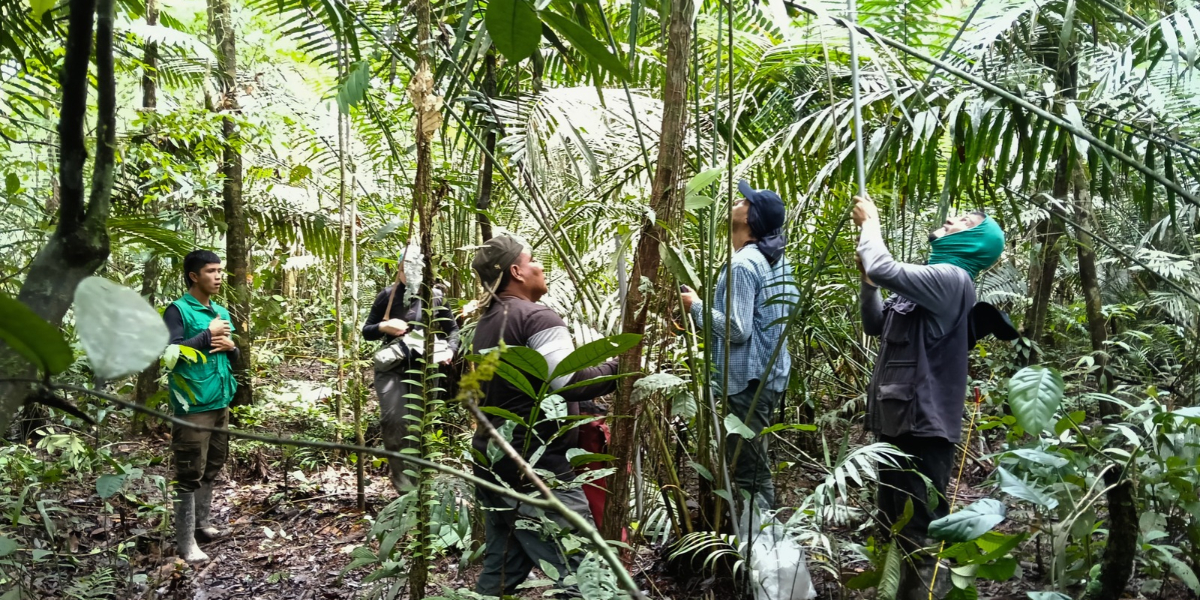
Bo’ Piyuya and the University of the Amazon are working to gain a better understanding of the region’s vegetation
In July, the ConBosque project continued its fieldwork alongside the Siona community of Bo’ Piyuya—the name given to this territory in their language, known in Spanish as Santa Cruz de Piñuña Blanco, in the department of Putumayo, Colombia.
A team of specialists from the University of the Amazon (Universidad de la Amazonia), led by Professor Marco Correa, collected plant samples as part of an operation carried out in the presence of and with the support of the local population.
As a first step, to assess the area’s biodiversity, various plant species were collected from a sampling unit—a permanent plot measuring 50 by 20 meters.
Next, the structure of the area was studied. To do this, two dimensions must be taken into account: vertical and horizontal. Along the vertical axis, tree tops and the vegetation profile are measured. Along the horizontal axis, trunk diameter at breast height (DBH) is measured.
Ultimately, the goal is to understand the structure and composition of the area’s vegetation.
How is this procedure carried out?
The two students and Professor Marco Correa, the researcher in charge of this project, established two permanent sampling plots, selected at random. Within these plots, data is collected on all trees, taking into account basic vegetation parameters such as diameter at breast height (DBH). DBH is a morphological measurement taken on each tree that is sampled and assessed. It helps identify the species and contributes to the analysis of the stand structure.
This methodology makes it possible to identify, using the collected sample, species that cannot be recognized with the naked eye in the field.
The samples are first dried and then laid out on sheets of newspaper. The numerous samples are then sent to the herbarium at the University of the Amazon for taxonomic classification of the species.
This type of methodology is important because it provides a baseline for the plant species present in the area through permanent fixed plots that are monitored every one, two, or three years.
It also aims to monitor changes in vegetation over time and to gather fundamental information that is essential for land management. Similarly, this allows us to infer which wildlife might inhabit the area. Indeed, there is a correlation between animal and plant species, as the latter provide their habitat.
How does the dialogue with the Bo’ Piyuya community fit into this?
The community participated in these activities as field assistants for the team from the University of the Amazon. But they also contributed to the collection of primary data on local plant uses, identifying how plants are used as remedies, building materials, firewood, and so on. This is another aspect that adds value to studies like this one. They foster a dialogue between science and the traditional knowledge of the Siona people regarding the use and management of plants.
In addition to being essential to the dialogue between different bodies of knowledge, community participation is not limited to simply collecting vegetation samples; community members are key stakeholders in the process and are kept informed of the results, which fosters a shared learning experience between science and the community. All of this information enriches scientific knowledge while introducing the community to the process of community-based forest monitoring. Through this approach, community members can learn this method and sustain it over time, integrate it into their everyday practices, and contribute to their conservation strategies.
Share This Story, Choose Your Platform!
What is your impact on forests?
What is your impact on forests?