
In July, the dry tropical forest conservation program continued its environmental assessment of the village of Pedregal through wildlife monitoring and a mapping workshop organized with the community. These activities brought together a total of twenty-three people, including children and women.
First, the results of the survey of landowners, which was completed earlier this month, served as the basis for a community meeting. Discussions then focused on Envol Vert’s philosophy and conservation principles before moving on to the mapping workshop.
Mapping the Mancomoján Forest
Participants created maps of Pedregal on which they identified natural areas and the threats to them. In fact, trees are regularly cut down in the reserve, which is also a hunting ground.
While the Mancomoján Creek—Pedregal’s other major natural area—has retained a large riparian forest (vegetation that grows along the banks of waterways), extending in some places up to 100 meters on either side, it is also vulnerable to logging and plastic pollution. During the workshop, some participants noted that in 1812 this stream was the site of a historic battle—to which it gave its name—during the conflict for independence from Spain.
The exercise also helped identify another stream—one that is less well-preserved—which originates in the reserve and flows near the hamlet. It had not been part of the discussions until now, and a visit is planned with the community to survey its bed—which is currently dry—in order to better assess its condition and identify potential areas for restoration.
Demonstrate the importance of wildlife
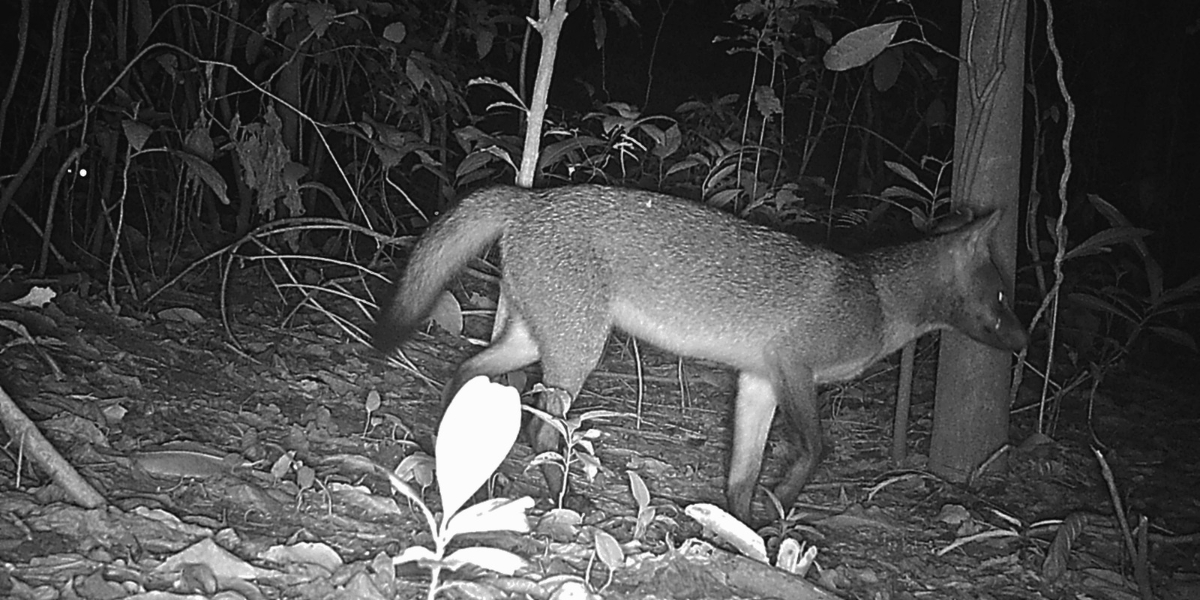
A wildlife monitoring study was conducted simultaneously in the forested area of Mancomoján, as this wide, continuous strip serves as an important ecological corridor. A first camera trap was set up facing an animal trail but far from areas frequented by humans or livestock, while a second was placed near a watering hole along the stream.
Various species of mammals and birds were photographed during three weeks of observation. At night, between 1:00 and 2:00 a.m., several nine-banded armadillos (Dasypus novemcinctus) were observed, as well as a crab-eating fox (Cerdocyon thous) and a common opossum (Didelphis marsupialis). During the day, the area was frequented by chattering ortalis (Ortalis garrula), doves, squirrels, and a rodent.
The presence of predatory mammals is an indicator of the ecosystem’s good conservation status in this forested corridor, which stands in contrast to the deforested areas surrounding it.
These data thus highlight the importance of the Mancomoján Creek as one of Ovejas’s main ecological corridors, connecting the upper reaches of the Montes de María to the lower areas, where only a small area of forest remains.
Share This Story, Choose Your Platform!
What is your impact on forests?

What is your impact on forests?