

The forests are burning and France and Europe are looking elsewhere
In 2024, 6.7 millions hectares of primary tropical forests were destroyed, which is as big as the Auvergne-Rhône-Alpes region’s surface area. A new record in twenty years. Despite this alarming observation and the historical and current responsibility of France and Europe in deforestation, actions to end imported deforestation are insufficient.
To estimate this responsibility and call on politicians, businesses, local governments and citizens to take action, Envol Vert has published its report : France’s Forest Footprint 2025.
1 football fields every 3 minutes
France’s Forest Footprint is 1 837 487 hectares. It is the deforested area caused by french importations since the deadlines set in the various agricultural sectors, i.e., the dates from which deforestation is taken into account. This represents one and a half times the size of the Île-de-France region, or 1 football field every 3 minutes.
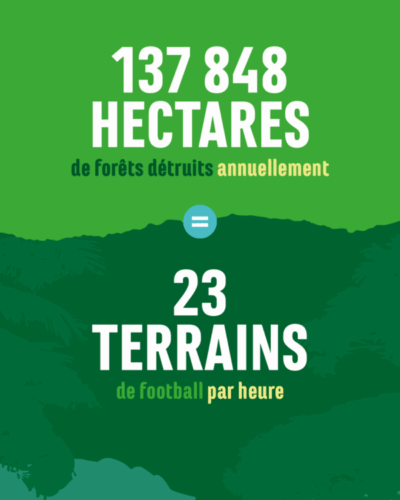
It is an alarming result, showcasing that deforestation is not just a legacy of the past but a crisis that plays out every year. The decisions taken today will determine whether, in ten years time, our Forest Footprint will have receded… Or whether our debt will have doubled.
A new methodology
Since 2013, Envol Vert has been working on a new methodology, capable of estimating the Forest Footprint, i.e., the surface area deforested to uphold the lifestyle and consumption of a given territory. This calculation method has been consolidated through the years, and in 2023 has resulted in the publication of the Référentiel Empreinte Forêt France (France’s forest footprint referential) or REFF, which was the outcome of several years of work from the Scientific and technical forest committee (CST Forêt).
This methodology is based on :
This approach makes it possible to publish :
Soy remains in the lead
Since the deadlines were implemented in the different agricultural fields, France contributed to the destruction of almost 1.8 millions hectares of forest area for its imports, the equivalent of 1.5 times the area of the region Île de France.
This number represents this cumulated forest footprint of french consumptions and illustrates the concrete impact of our imports on world deforestation.
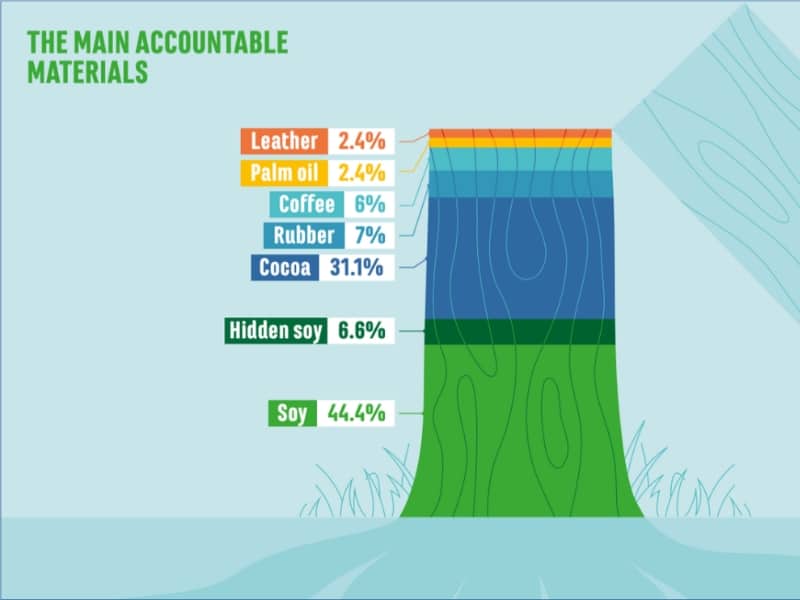
Reference dates : 2014 for cacao and coffee, 2008 for soy, hidden soy and palm oil, 2019 for rubber, 2009 for beef and leather.
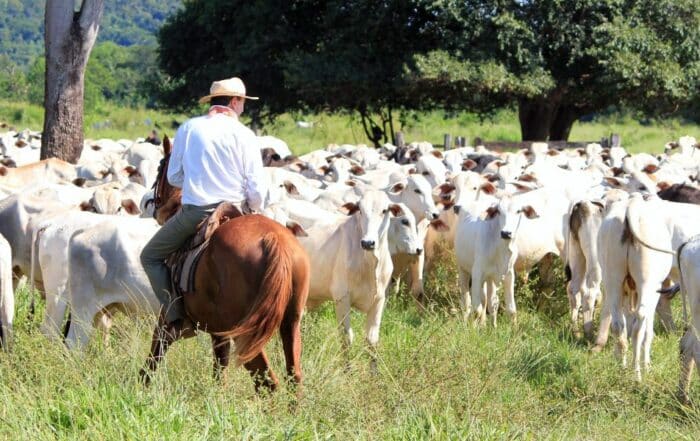
Like in our precedent report of 2018, soy is the principal culprit of France’s Forest Footprint. Whereas 87% of soy imported in France is destined to animal feed, it is meat consumption and animal products that explain this top position. It needs to be distinguished from the one for human consumption (tofu, soy milk, etc…) which is primarily produced in France and Europe.
We are decrypting the seven principal raw material fields responsible for deforestation, included in the European Regulation on Deforestation-free products (EUDR). Which are soy, cacao, palm oil, coffee, wood, rubber and beef (meat and leather).
Anticipating tomorrow : the other raw materials
So as to anticipate the emergence of other raw materials which pose a risk of deforestation, and which are not or sparsely taken into account in today’s regulations, we are proposing to circle back on some of them.
If their worldwide impact is still low, it is imperative to consider those other materials. Some of them are experiencing particularly strong growth, and the pressure they exert on ecosystems may only become fully apparent in a few years time. This is particularly true for the pineapple cultivation in Costa Rica, which has seen its production increase from 10 000 tons in 1980 to almost 3 millions tons in 2023.
Other materials can have a really localised impact, like the old exploitation in Peru, which is the principal cause of deforestation in some areas of the country. Mineral extraction needs at large a particular attention since its impacts extends far beyond deforestation, provoking a strong pollution well beyond the directly destroyed areas.
Our main recommendations
We are suggesting a list of recommendations aimed at four major groups of stakeholders : the State and the European Union, businesses, local authorities, and citizens.
They are numerous, but here are the four main ones :
Share This Story, Choose Your Platform!

What is your impact on forests?
What is your impact on forests?