Environmental Education in Pichanaki: Children Discover the World of Birds
As part of the ConBosque project, participants—with support from Envol Vert—continue to carry out activities aimed at conserving the forest through participatory science and economic alternatives to deforestation. Since the start of the school year, the communities of San Luis Alto Ipoki, La Nueva Florida, and Ayte, in Pichanaki (Junín), have been the setting for an environmental education strategy that is progressing month by month with elementary and middle school students.
A Comprehensive Educational Approach
The first workshops of this second year of training focused on the forest’s ecosystem services: what the forest provides to those who live there, from the water they drink to the air they breathe, including food and the regulation of the local climate. In April, the focus shifted to water itself: rivers, rainfall, and the hydrological cycle that makes life possible in tropical ecosystems. Through audiovisual resources and guided discussion, the children began to understand the forest not as a backdrop, but as a dynamic system of which they are a part.
May, the Month of Birds
May was dedicated to birds. With the support of specialists from the National Service of State-Protected Natural Areas (SERNANP), the workshops encouraged the children to observe their surroundings with a specific question in mind: Who lives in the trees around us? They learned to analyze birds from a scientific perspective—examining their anatomy, the shape of their beaks as an indicator of their diet, and their behavior—and to understand their ecological role in maintaining the forest’s balance: seed dispersal, insect control, and serving as indicators of ecosystem health.
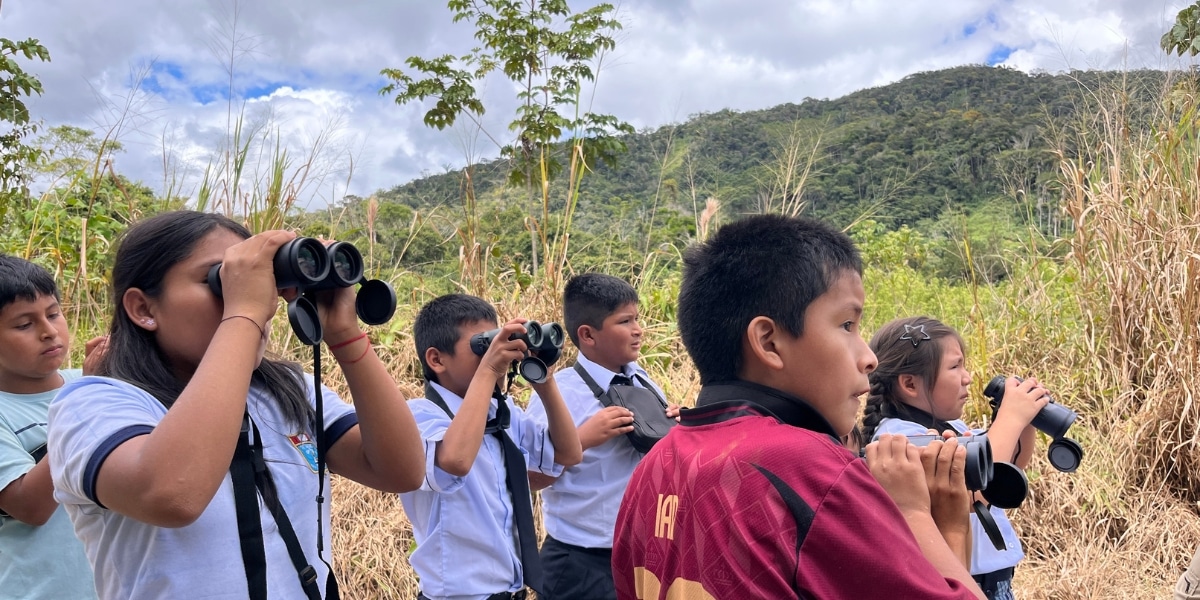
To extend this learning beyond the classroom, bird-watching outings with binoculars were organized in nearby forested areas. For many, it was the first time they had held such an instrument in their hands, and the discovery that they could bring a distant bird closer simply by adjusting a lens was, in itself, part of the experience. Each participant also received a birdwatcher’s notebook—a tool designed specifically for children that allows them to record their field observations and deepen the knowledge gained in the workshop. In total, 40 children participated in three enriching sessions.
June: Exploring the Flora
The program continues. In June, a new field trip will take participants to identify trees and medicinal plants in the area, recording their findings on botanical data sheets that will form the basis of a collective herbarium. In July, the focus will shift to culture and environmental memory—including Amazonian myths, worldview, ancestral knowledge, and the territory—with direct encounters with community elders, an art workshop, storytelling sessions, and walks featuring oral history. After a break in August, the second semester will address threats to the forest, such as human activities, biodiversity loss, and climate change. The year will then conclude with a community reforestation day in which the children will take on the role of Forest Guardians.
A program that began with the question “What is the forest?” is moving forward, workshop by workshop, toward a more challenging one:
“What can we do to protect it?”
Share This Story, Choose Your Platform!

What is your impact on forests?
What is your impact on forests?