Connaissez vous la succession écologique ?
Ecological succession is the natural process by which an ecosystem evolves and develops through a series of stages: from initial recolonisation to a theoretical stage known as the climax stage. To put it more simply, as a general rule, leave a space to its own devices and it will gradually be colonised by plants, mosses and fungi, growing ever larger and taller until it eventually reaches a forest stage.
Nature therefore tends to favour forests and trees, but how can we use this principle to facilitate the establishment of agroforestry systems? This is where assisted natural regeneration (or ANR) comes into play.
What is it?
Assisted natural regeneration (ANR) involves facilitating the colonisation of a specific area by a range of plants that will grow ‘naturally’, using seeds present in the soil or introduced for the purpose.
A colonising hedge will therefore go through various stages in succession, its composition changing as plant succession takes hold:
So how can hedgerows be established using RNA?
There are various ways of doing this. At Envol Vert, when we began experimenting with the RNA in 2023, we focused on dry hedge projects, made up of dead, interwoven branches, which are perfect for providing biomass and serving as a biodiversity refuge. Unfortunately, the time spent finding the branches and putting them in place was far too great – sometimes even greater than organising planting projects – and hindered our other activities.
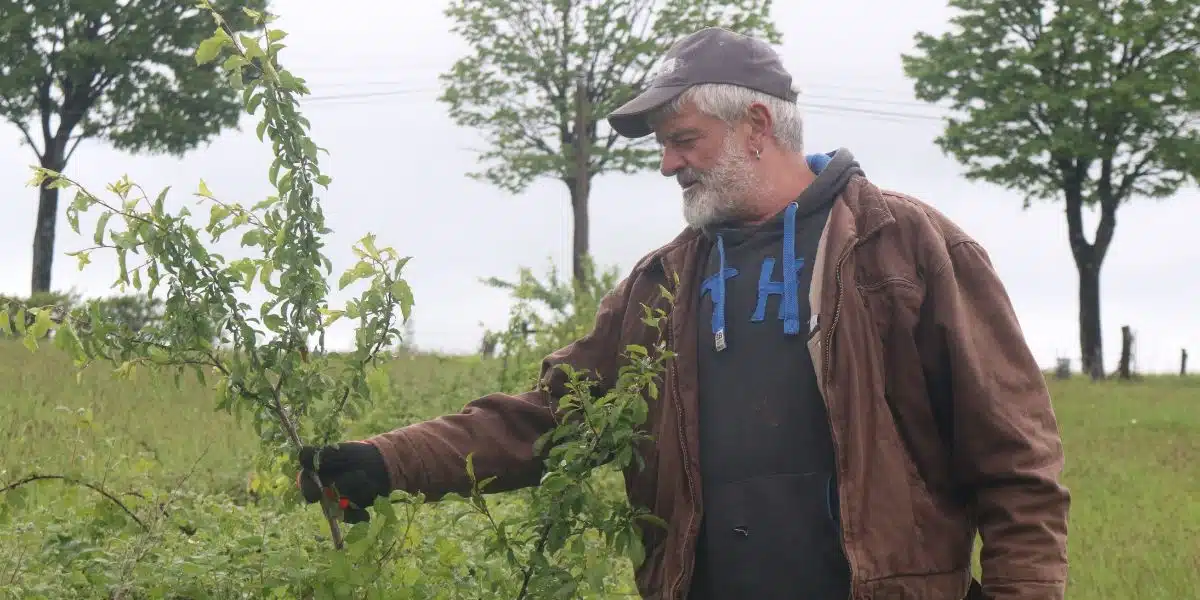
So we moved on to two other techniques: creating a sanctuary and sowing seeds! Creating a sanctuary is one of the simplest processes to implement; all you need to do is fence off the area you want to leave to develop naturally. Tree seeds are already present in the soil and brought in by birds. All you need to do is give it time and, from the trees and shrubs that grow in the early years, select those that are of interest to our system. Thanks to this method, we have been able to establish no fewer than 2,500 linear metres of RNA this year, to be ready by 2025.
As for sowing seeds, by drawing on experiments carried out in the Grand Est region and sourcing our supplies from seed suppliers in the south, we were able to obtain over 3kg of seeds from our south-western terroirs and other more Mediterranean regions. These seeds were distributed and then broadcast-sown in late February and early March. We were thus able to establish 2,200 metres of hedgerows which, in a few years’ time, will be perfectly integrated into the agroforestry systems of the farms where they were sown!
Share This Story, Choose Your Platform!


What is your impact on forests?
What is your impact on forests?