What if observing animals directly were not essential to understanding biodiversity?
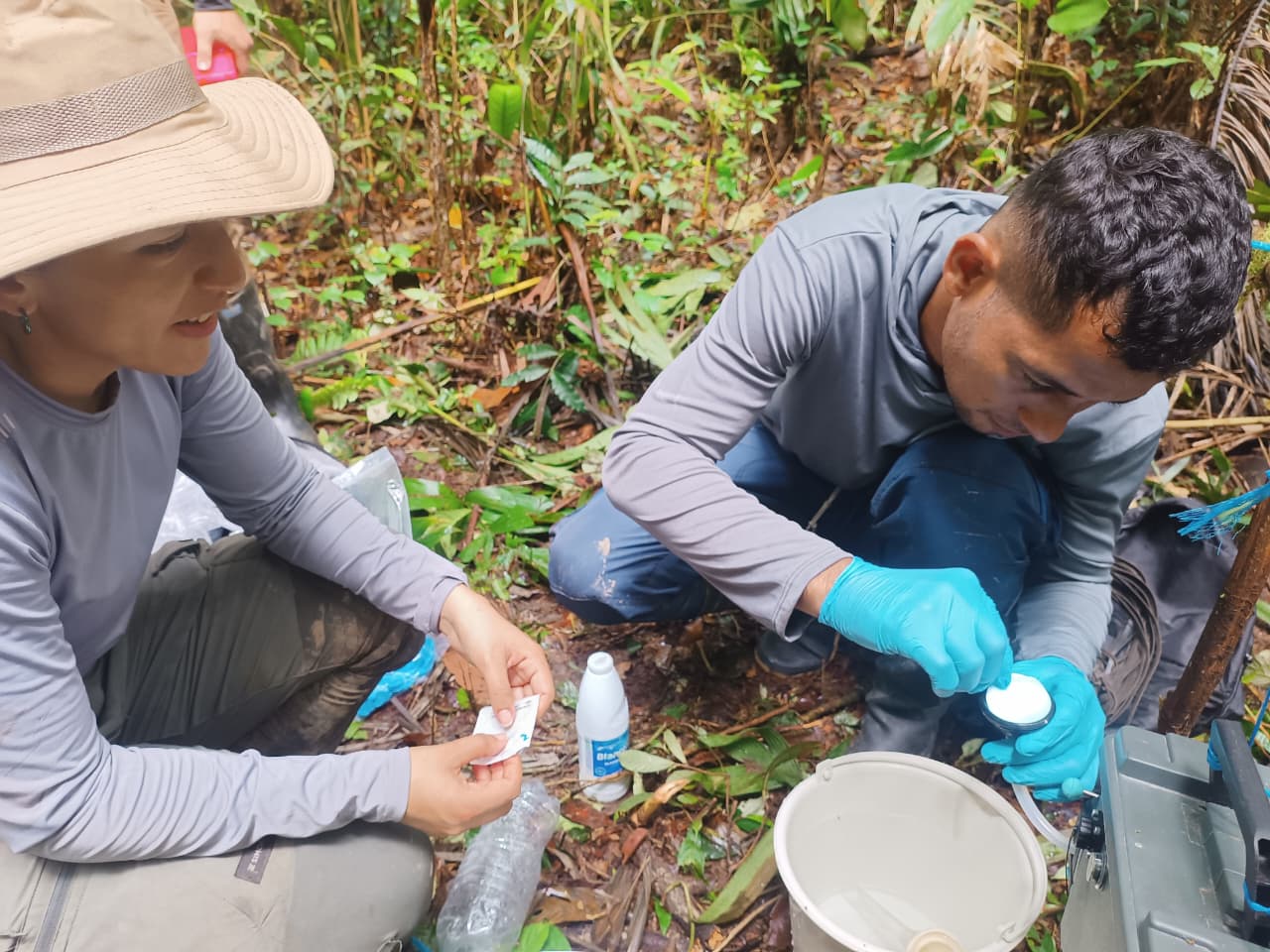
An innovative method known as environmental DNA (eDNA) provides highly valuable scientific information and offers a different approach to strengthening forest conservation. Based on detecting tiny, invisible traces left behind by species, such as skin cells, this method is being introduced for the first time in the rural communities of Solano, in Caquetá. The initiative is part of the ConBosque project, funded by the French Global Environment Fund (FFEM) and implemented by the Amazon Conservation Team (ACT) and Envol Vert. In April 2026, awareness-raising sessions on environmental DNA were organized with the farming families participating in the project. Following the collection of twenty water samples and their analysis at strategic sites by the ACT and Universidad de los Andes teams, participants were able to discover the potential of this tool for the Colombian Amazon’s forests.
A Community-Based and Participatory Day as Part of the ConBosque Project
Understanding the biodiversity of a given territory can involve detecting skin cells, mucus residues, scales, or organic matter deposited in the water as animals pass through. Detecting their presence in this way is much easier. The ConBosque programme aims to improve understanding of the biological diversity of priority areas within the municipality. As part of this effort, awareness-raising sessions were organized with the farming families participating in the project. The aim was to introduce the environmental DNA methodology and plan the monitoring process. The entire process was carried out in a participatory manner, and dialogue led to the selection of the area where the first sampling campaign would take place: La Bamba.
A Scientific Intervention in Water Bodies Using Environmental DNA
From July 7 to 10, 2026, the technical team from ACT and Universidad de los Andes, accompanied by members of the local community, surveyed different areas of the vereda in search of sites with high conservation value. The objective was to collect 20 water samples from strategic locations, such as wildlife crossings and natural salt-lick sites. Each water sample was filtered according to specialized scientific protocols designed to capture the genetic material that organisms naturally release into their environment. Unlike other monitoring methods, environmental DNA is a non-invasive tool, as it does not require wildlife to be captured, handled, or disturbed.
Analysis of these samples will make it possible to establish an inventory of vertebrate species present in the territory, including species that are difficult to detect because of their nocturnal habits, elusive behavior, or low abundance.
A Meeting for Sharing Knowledge and Experiences
Beyond the fieldwork, the day also provided an opportunity for participants to exchange knowledge and experiences. Through everyday examples, participants learned that DNA functions like a unique “fingerprint” that every living organism leaves in its environment, making it possible to identify which species have passed through a particular location simply by analyzing the water.
The community’s interest in learning about the results was reflected in the words of Jairo Marín, owner of Villa Marín farm, who highlighted the value this information could have in improving understanding of the wildlife present on his land:
“I understood that DNA can be used to see how many animals there are in the forest, in the area, in the territory where we are. There may be animals that we would hardly believe live here. It would be good if, later on, we were given a list of the animals present in the area.”
The Positive Impacts of Environmental DNA
This type of scientific tool will not only deepen knowledge of biodiversity within the municipality, but will also strengthen community-based conservation processes. The results will provide a baseline for wildlife monitoring, land-use planning, and decision-making aimed at protecting the ecosystems that support the livelihoods of farming families. The implementation of environmental DNA demonstrates how science and local knowledge can complement one another to generate valuable information, strengthen participatory territorial management, and promote innovative strategies for conserving the Colombian Amazon.
Share This Story, Choose Your Platform!

What is your impact on forests?
What is your impact on forests?