
For the past four years, the SEVE project has relied on CCF as the basis for all its activities, including support for forest owners, management of forests acquired by the GFC, and awareness-raising initiatives. CCF, or continuous cover forestry, is a form of forestry that advocates, among other things, maintaining forest cover on the plot, mixing ages and tree species, and ‘tree’ rather than ‘plot’ forestry. It is opposed to even-aged forests, which contain only trees of the same age on a single plot, and clear-cutting or clear-felling, which removes all trees from a plot at the same time. CCF is based on several principles, including supporting and respecting natural processes rather than disrupting them, and relying on the multifunctionality of the forest. In other words, it promotes all the ecosystem functions and services provided by the forest, beyond timber production, such as its role in hosting biodiversity, its landscape function, its recreational function, its CO2 storage function, etc.
It generally focuses on producing large timber of the highest possible quality, with more frequent but lighter thinning. It seeks to preserve trees that provide microhabitats and dead wood as soon as possible in order to protect elements that are home to a large part of the forest’s biodiversity. Finally, it pays particular attention to timber harvesting in order to avoid soil compaction and preserve the forest ecosystem, notably through gentle logging techniques such as horse logging.
CCF is therefore a gentle form of forestry that allows logging to be carried out while reconciling it with the preservation of biodiversity. In particular, by mixing species, it provides greater resistance to pathogens than monoculture, as well as greater adaptability of the plot to climatic hazards. It also promotes CO2 storage, biodiversity and forest soil protection.
The SEVE project promotes this approach at various levels and to a variety of audiences, both through awareness-raising workshops in schools and through recommendations to forest owners on how to manage their land.
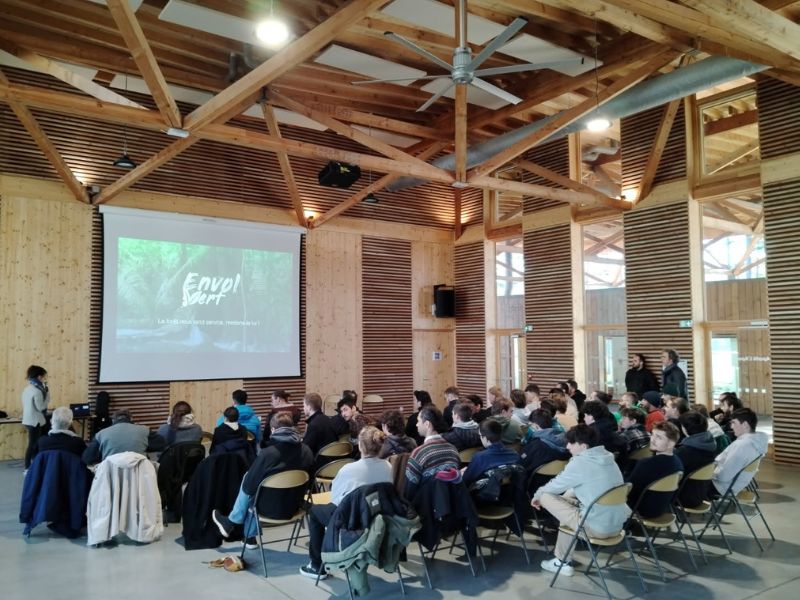
For example, on 22 November 2025, Envol Vert spoke to future cabinetmakers to raise their awareness of the challenges of sustainable forestry and sustainable wood supply. After presenting the association and the SEVE project, Envol Vert discussed CCF and its benefits, followed by a presentation by Anthony Viste, who spoke about his work as a luthier and his responsible wood sourcing practices.
The half-day event was part of a weekend for around fifty cabinetmaking students with the Compagnons du Devoir, a target audience for the SEVE project, which seeks to raise awareness among future professionals in the wood industry. It provided an opportunity to reach out to future cabinetmakers and raise their awareness of the challenges of responsible wood sourcing and sustainable forestry.
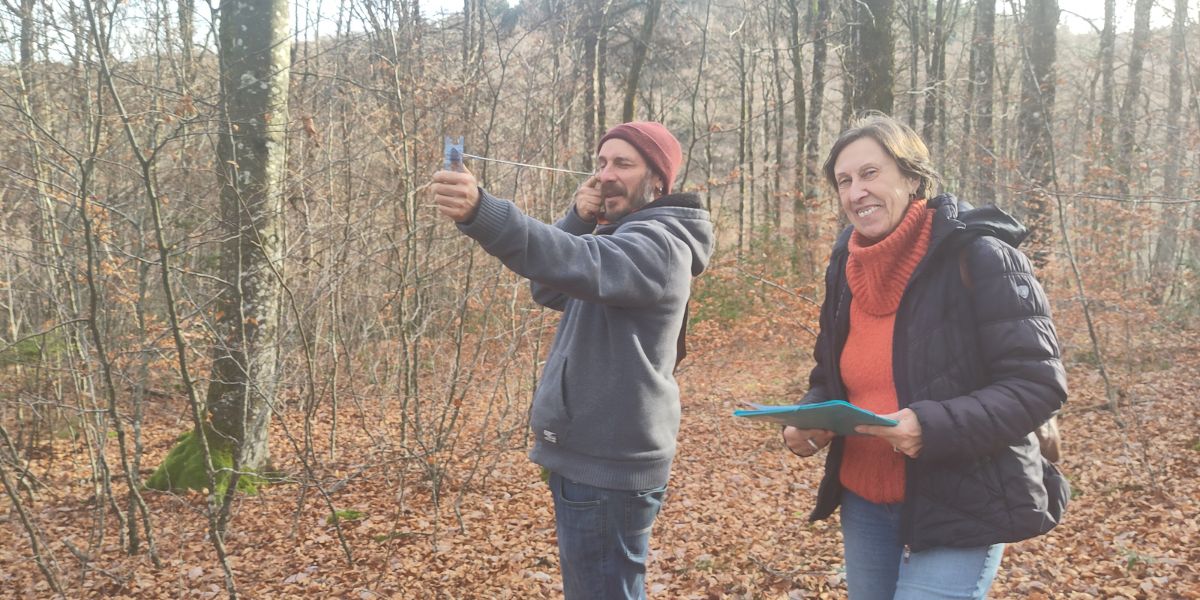
In addition, on 29 November 2025, Envol Vert held an introductory day to the CCF in the commune of Anglès for forest owners. Ten participants attended the day, which included a theoretical session in the morning followed by a practical demonstration in the forest in the afternoon. Participants were introduced to the basics of forest management in uneven-aged forests, including how to use the relascope tool to measure basal area, tree marking exercises, and measuring the potential biodiversity index. This introductory day marked the end of the 2025 promotion for landowners whose plots Envol Vert had assessed and for whom it had formulated CCF management recommendations.
By reaching out to a diverse audience at a variety of events, the SEVE project hopes to help promote CCF in the Haut Languedoc region as an alternative forestry model.
Share This Story, Choose Your Platform!


What is your impact on forests?
What is your impact on forests?