Introduction
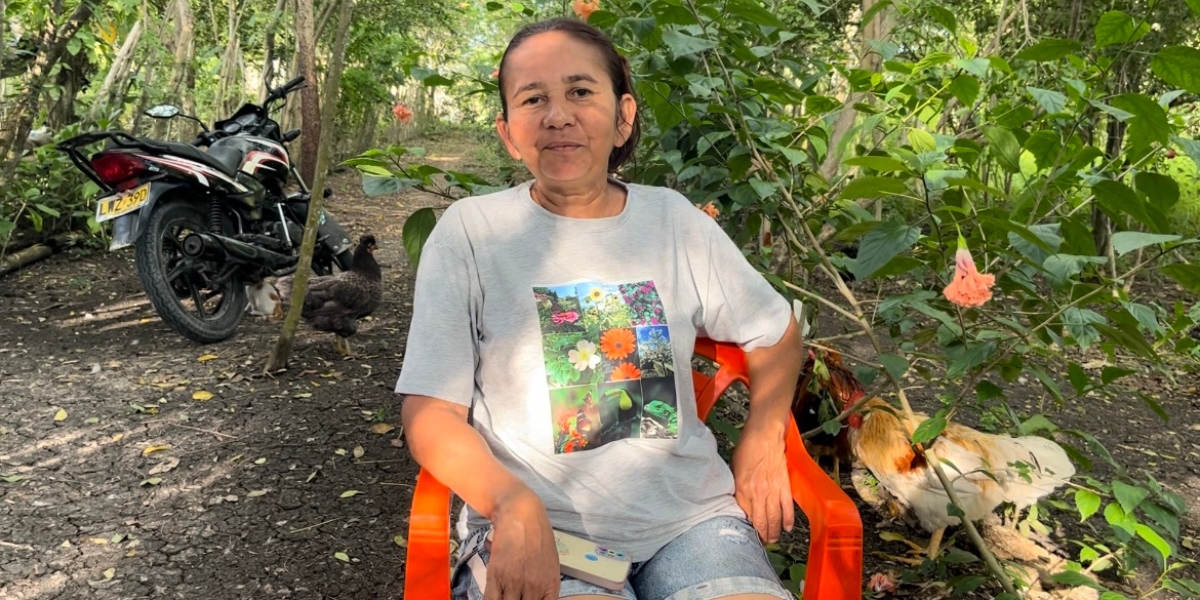
“My name is Patricia Chamorro Arrieta. I live in the village of Villa Colombia, in Ovejas, and I am a farmer. I have been participating in the Dry Tropical Forest project with Envol Vert for six years now. I am very happy with this beautiful process and have great hopes for the future: for my family, my community, and all future generations to whom I hope to contribute my small part.”
What do the project’s economic alternative activities involve?
“Within the project, I see economic alternatives as an opportunity for all the families involved—and by ‘families’ I mean the members of a given community. We work especially with an endemic product of the tropical dry forest: the guáimaro, which we use both productively and as a source of ancestral knowledge passed down around its cultivation and management.
The possibility of preparing different products from this resource (flour, sweets, etc.), while at the same time participating in economic alternatives to deforestation, represents a fundamental added value for my commitment. In this way, we develop economically in our territory, transmit knowledge, and gain a much-needed autonomy, all while conserving the forest.”
What has this process contributed at the individual level, for your family, community, plot, or forests?
“This process has allowed us, both individually and collectively, to transform our practices. In the past, we used methods that were very harmful to the forest, such as agrochemicals, slash-and-burn techniques, and timber extraction, among others. But since we started cultivating our plots, trees have grown back, we are surrounded by vegetation, and this has also led to a change in our quality of life: my family feels happy when they visit my plot, when they see my garden, my home where we keep the products we cultivate; there has been a real improvement in our living conditions.
I have realized that, with few resources, it is possible to conserve and improve our practices and knowledge every day to collectively care for our environment, and to make use of the resources we have to ensure food security for our families. Today, I have participated in very interesting and constructive programs with Envol Vert, and I hope to continue learning and supporting in the best way possible.”
What is missing or what could be improved to consolidate results in your territory?
I think the most important thing is to keep bringing together people from the territory and from other communities, to encourage them to change their habits, participate in these processes, and discover the wonders of their forests and lands, as well as to communicate our actions as widely as possible.
This seems key to me to continue advancing, because every person who acts generates a positive or negative impact depending on their practices. That is why it is necessary to tip the balance, so that one day the majority of us are those who care for our cultures, our forests, and our ways of consumption.
Share This Story, Choose Your Platform!


What is your impact on forests?
What is your impact on forests?